Westfalia Interior Descriptions '58-'67
by Susan Crandall
Remember this article is meant to be an overview or an introduction anda way to describe as many features as we can. It doesn't mean it's gospel. Owning Volkswagens should make you aware that every country kept features for a different length of time and that Volkswagen subscribes to the left over theory. If it's left over just put it onthe first ten or first two hundred models of the next year to confuse everyone!
During the early sixties the idea of a "ready to go" camping vehicle seemed to have caught on in Europe and especially here in America. Volkswagen had already made in roads with this new market as early as1952, when they made available roof racks and awnings. In America, interest in the camping vehicle steadily grew right through the end of the split window era and beyond. Some of the refinements that we've seen are still being used, some were discarded as impractical.
Camping Box
Westfalia did incorporate distinct styles of kits in the early buses through 58, unfortunately not many good examples exist today. Whatmakes theses kits unique was the large use of wood (not much plastic there) and a fairly simple design. 1953 introduced the camping box. Aremovable box that would allow part of the kit to be removed to be used as a sort of chuck wagon by the picnic table. One of the models used arollback bread box style cabinet as rear compartments. The camping box expanded to "standard" and "export" models in 1955. In 1956, the kits were renamed "standard" and "deluxe". These early models used a set of very prominent decals with the Westfalia horse logo. Most unusual of all were 2 large red fuel containers for an optional Westy cooking stove. (pretty high on my cool factor) While the sleeping cot was primitive by later standards, it was very functional. Available from 1952 to 1964was the operable steel hatch in the roof so you could enjoy the good weather and the stars at night or let the bus fill up with water if you forgot to close it tightly.SO-23
1958 brought about the deluxe SO-23. SO designations come from "sonderausfuhrung" meaning special model or edition. The original standard SO22 camping box was still available and possibly was available through1966. We are unsure of this total timeframe. Offering the same basic design 58-61 Westfalia was using the 2 rear seats with 2 back cushions to form a bed. Either red and black or yellow and black plaid were thechoices for upholstery. Cabinets were made of plywood veneer with woodfinish, the doors of cabinets were oval or half rounds with metal edging. Early style child's hammock using same plaid as rear bed hooked around back of front seat to make a small hammock and bottom of frontseat could actually hold another child. These campers came with or without an ice box section that included another storage compartment on thedriver's side above the engine compartment. Also as an option was anelastic catch all for shoes across the ceiling of the rear area. These campers came with the highly sought after spun colored aluminum drink sets in the clear bread box display cover. There were your basic cocktail 6 oz cups and your accompanying shot glasses. There was anenormous water tank that took up half the area under the seat behind the driver that operated on an electric siphon hose. There were 2 clamshell side lights and an abundance of homey charm. There were 2 tent options. Small foyer and large cabana room. A lot of busses came with both sets of mounts on the roof hence the four mounting eyes on early Westys. To increase the amount of stuff you could bring, Westfalia racks started to appear regularly. A rack from this era is distinctivefrom a side profile. The back bow has a lower profile than the other 2,or look at the attaching clamps. They are smaller without press marks from stamping. The wood slats were screwed with 2 screws instead of oneas in later racks. The later racks all had equal bow height. In 1960 the "MOSAIK" program was introduced to create more optional kit offerings. With the MOSAIK program you could buy just the camper pieces you could afford or really wanted. Additional pieces were available through the dealer.SO-34 and SO-35
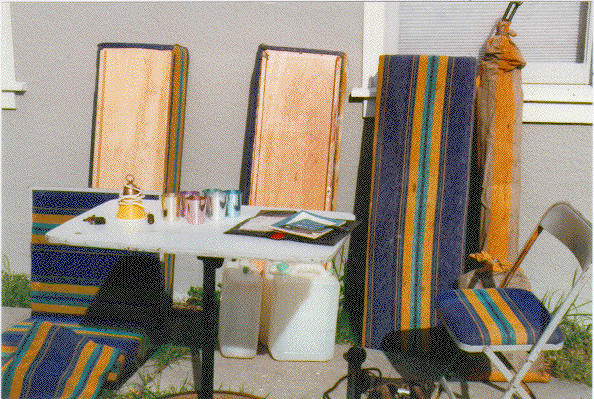
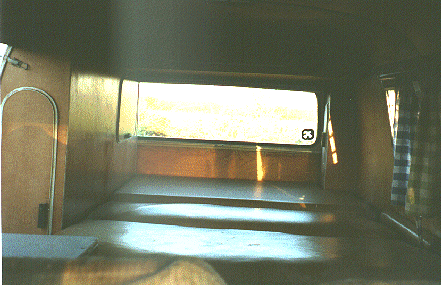
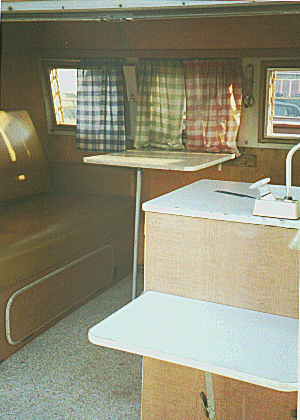
1962 brought out a different kit altogether. The SO-34 or 35 depending on the upholstery. While the flip top hatch was retained and the hanging locker and rear cupboard unit was in the same place everything was different. From a kid�s perspective it is also the "funnest" year.The hanging locker unit was wider than before. The camper interior was arranged for seating looking out the side doors rather than facing each other front to back. The bed was made up from 3 narrow (uncomfortable) cushions going lengthwise in the middle of the bus that used the front seat and the fold up middle seat in the rear tunnel as extensions for tall people. Extra seating for socializing was provided by spinning the back of the front seat 180 degrees on swivel arms accessed at the front doors. The seat back completely flipped around so from the side doors you could access the entire bench seat now facing backwards. So in addition to the bench seat facing the double doors there was one across the front of the bus and in the tunnel or alley in the back in front of the engine compartment a single seat flipped up. An optional item was also a small standard folding chair that clamped to the floor for travel in front of the hanging locker. The table screwed into the floor but could swivel on a bent arm that allowed the long way to be either horizontal or vertical across the bus. But the best part about the table was its ability to come out of the bus and be used. Why did they ever give that idea up?
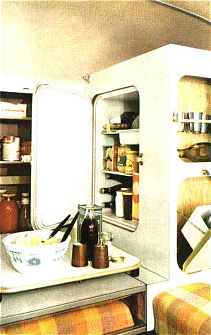
SO-34/35 parts photo by Michael Heron.The back of the bus under the rear hatch was the primary access to the kitchen area. Facing the rear of the bus the left hand unit had a large fold down doo to act as a flat surface with 4 recessed shelves to hold canned goods, silverware, condiments, fuel bottles, cups,etc. and in front of that was the icebox. On the right hand side was a cupboard with 2 side opening doors behind the hanging locker. But if the weather was inclement just unbolt the kitchen fastener and swing it around on its roller wheel to face the interior of the bus and work from there albeit hunched over. The swivel unit itself had logical storage and even accommodated the stove when you were ready to pack up. No digging under the bed for kitchen stuff. While the unit was swiveled forward it allowed access the spare tire behind it. By taking the spare tire out and laying it flat on the ground, with the plate that came in it you could mount your table to the tire and have a little serving table or prep table wherever it was most convenient.
On the front of the ice box facing the front of the bus was a very early sixties traditions, the bar. The upper cupboard sported the traditional spun aluminum glasses in the 8 oz size with space for your own extras and the bottom cupboard tilted out with cutouts to support two fifths of your favorite before dinner beverage and storage for a third. This was definitely a martini crowd camper!
This year introduced the common green child's hammock that we saw through 1967 and its basic style is still used in today's Westys. The "social" frontseat swiveled to a 90 degree rotation to form the lumpy support underthe child's hammock if needed but also opened up the front seat to be the overflow foot room for the main bed. This year instead of the traditional wood finish the white laminate with the gray dashes and lines was the indestructible material for the cabinet surfaces.
The upholstery was either yellow/orange plaid with a red vinyl front seat or blue/green plaid. Instead of a water tank and pump this model came with 3 water jugs. Very handy to take out of the bus and use anywhere and refill. One of the most novel ideas was that of a movable light. Alittle cone shaped patio lamp on the end of a lamp cord that plugged into a cigarette lighter like opening and could be hung from various hooks or even hung from the tent made seeing what you were doing a breeze. This kit has been seen in 1963 which appears to be a transition year, sharing most designs with 1964 but not quite.
1963 and 1964
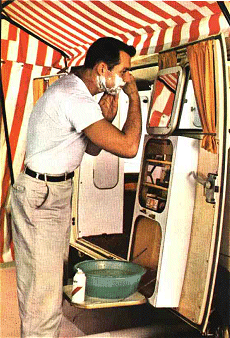
Interestingly the 1963-1964 kit is reminiscent of the 1958-1961 kits where the 2 back seats oppose each other and the table affixed itself inbetween them. To make the bed the seat bottoms slid to the middle andthe seat backs came off and were used to fill in the gaps. The rear seat back fit fine as is but the front seat back was thinner and needed to use lifters to level out the bed. These were the little hinged pieces of wood inside the forward seat compartment. Under the seat bottoms were huge storage areas. A lawn chair easily fits in the storage compartment. The cupboards had squarish doors with roundedcorners trimmed in plastic but instead of the wonderful brass swivel latches used previously Westfalia attempted to copy a cheap American camper design and went to plastic pull knobs that bent broke and fell apart. The conical light remained through 1965. 1964 marked the last year of the real wood finish. It was also the last year for the fliptop and the first year of the large rear window. Seat cushions were still the yellow/orange or blue/green plaid Pendleton wool material. On the front side door was the �bathroom� with a rectangle cupboard divided in half. The top opened up and had 3 shelves with a mirror on the inside and snapped to the door and the bottom folded down and was held perpendiular with a chain and the cupboard held a �dishpan/bathroomsink�.SO-42
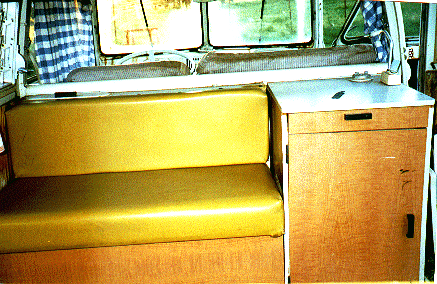
1965 brought out a totally different kit and certainly the one that is most familiar to everyone. It was known as the SO-42. What really made this kit different was the use of a retractable (very comfortable withsprings) Z bed which allowed instant sleeping arrangements and could be put away again post haste. Coupled with the new fiberglass top and canvas side straight up pop top there was plenty of room to move around in. They finally brought the ice box to a more accessible area in aself contained cabinet just inside the front double door where it could be opened from inside or outside the bus. This unit also housed the upright water tank and excellent plunge pump dispenser. No sink was installed, so there was room for a utensil drawer and a more useful flatcabinet top. The cushions were covered in easy to clean solid color vinyl for the export market or the yellow/orange plaid was available generally in Europe. The side lights were covered with rectangular slide out covers and there was no conical light with this kit. This kit came in a walk through style with a single seat behind the driver and maybe a lid on the map storage section in between the driver and rear passenger or maybe not, or with a three quarter bench with a built in map junk compartment with or with out a lid that a small child could sleep on. If it wasn't a walk through then there was a narrow what-not cupboard in the rear corner of the bus on the driver's side. A surprisingly roomy cupboard went across the top rear. A full week'sworth of clothes for one person could easily fit there. The rear access hatch for the space behind the hanging locker opened up, rather than sideways as in the past. Some how you had to hold up the hatch and dig around in the depths to find what you were after. A snap strap to hold it open like the kind used above the table to hold the table up and out of the way would have been handy. The table was permanently hinged to the side of the bus and would fold down against the side wall out of the way or swing up to the roof. The child's hammock remained an option. The most practical addition was the what not cabinet on the rear sidedoor. It holds a ton of food, spices and glassware. The two fold up tables one on the front door and the other on the side of the ice box under the pivoting arm of the water dispenser made an easy working areaunder the awning. To add a little sleeping room a factory option sparetire mount could be ordered right in the middle of the space for the front emblem. Or for those Alaska hiway trips you could bring two spare tires. Since camping is sometimes done in the rain the jalousie windows and screens made water and bug proof cross ventilation possible. The SO-42 sold for 1850 dm in 1965. Basic components of this kit can still be recognized in the newest offerings from Westfalia even today.SO-44
Also available starting in 1965 was the SO-44 kit. It employed a significantly different interior layout. It was for non walk throughbuses with the bulkhead behind the driver made up of a kitchenette with a flip over cover and a hanging locker directly behind the driver. Inside the lid of the kitchenette there was space for a stove or work area and a small sink. In 1965 water was obtained from siphon pumping from two removable bottles while later there was an installed watertank. There were three doors on the kitchen section the one closest to the outer doors was the ice box. The middle one had 3 small utensil drawers and storage for the bottles. The one by the hanging locker had 3 shelves and plenty of storage for canned and dry goods. Instead of a fixed dinette table the table was on a moveable swivel with a small jumpseat between the hanging locker and the huge Z bed. The Z bed went wall to wall and like the SO-42 was a spring bed with all the size and comforts of home. What a difference a foot makes. There were cute armrests on either side. The yellow naugahyde was the usual upholstery. Hanging from the roof in the rear and extending from side to side of the bus was an optional 3 section clothes compartment. Great for extended storage but almost completely blocks the view out the back window. Frequently found in this kit was the small hanging light with the adapter hole. This kit was a bit more money at 2540dm.While there is no ultimate year by Westfalia all models have a favorite feature. It is the imaginative designs that have made owning and restoring Westys a real treat.